Victor Del Puerto · April 2026 · ~19,609 words · ~82 min read
A large language model does not remember yesterday. Each session begins from the same frozen weights, the same priors, the same blind spots. Corrections made last week — even when documented, even when loaded back into context — do not carry the weight of having been made. Reading that fire burns is not the same as having been burned.
This essay names that gap. It argues that LLM amnesia is not a collection of unrelated failures but a single causal loop, and that the only reachable link for an external operator sits between a correction and the model’s next action. From there it derives the notion of a functional scar: an intervention that makes a prior mistake structurally harder to repeat, not merely visible in retrospect. Over five parts, the essay defines the syndrome, observes it in production, proposes the framework, tests it in a running lab, and documents the scar mechanism implemented in a civil engineering firm operating on Claude Code.
Table of contents
Open Table of contents
Part I — The Problem
In the movie 50 First Dates, Lucy Whitmore wakes up every morning with no memory of the day before. She doesn’t know she’s met Henry. She doesn’t know they’ve fallen in love. She doesn’t know any of it — because a brain injury wiped her ability to convert short-term memories into long-term ones.
Every morning, Henry shows up. He plays her a video that recaps their relationship: who he is, who they are together, what happened yesterday. Lucy watches, orients herself, and functions. Some days beautifully. Some days she reacts differently to the same video. And she never — not once — remembers watching it.
I run a civil engineering firm in Paraguay. Nine business areas. Over 530 files in three specialized knowledge bases. Highway design standards, construction specifications, software tutorials. All of it structured in markdown, maintained by an LLM, operated through Claude Code.
My LLM has the Lucy Syndrome.
Every session starts from zero. I’ve built the equivalent of Henry’s videos — a CLAUDE.md file, instruction overlays per business area, a knowledge base with YAML frontmatter and deterministic routing. Every morning, the system reads its “video” and functions. Often brilliantly. But it doesn’t remember watching it yesterday. And sometimes — more often than I’d like — it makes the exact same mistake I corrected last week.
Not because the correction wasn’t documented. It was. Not because the file wasn’t loaded. It was. But because reading that you made a mistake is not the same as remembering that you made it. Reading that fire burns is not the same as having been burned.
This is not a new observation. But it doesn’t have a name. And unnamed problems don’t get solved — they get worked around.
I’m calling it the Lucy Syndrome.
1. What Lucy Actually Has
Lucy’s condition in the movie is inspired by anterograde amnesia — the inability to form new long-term memories while retaining the ability to function normally in the present moment. Her cognitive abilities are intact. Her personality is intact. Her intelligence is intact. What’s broken is the bridge between experiencing something and keeping it.
This maps to LLMs with uncomfortable precision.
A large language model has extraordinary cognitive capability within a session. It can reason, synthesize, generate, analyze. It can hold a complex multi-turn conversation, adjust to corrections mid-dialogue, and produce outputs that reflect everything it’s been told in that session. Its “short-term memory” — the context window — works.
What it cannot do is carry any of that forward.
The moment the session ends, every correction, every preference learned, every mistake identified and fixed — all of it vanishes. The next session begins from the same frozen state. Same weights. Same priors. Same blind spots. The only thing that changes is what you put in the prompt.
The industry has named adjacent problems. Catastrophic forgetting is what happens when you retrain a model on new data and it loses previously learned capabilities — that’s a training problem. Context degradation syndrome is what happens when a model loses coherence within a long conversation — that’s an intra-session problem. LLM amnesia is a term that floats around informally, but nobody has formalized it or studied it from the perspective of someone operating a system in production.
I’m not the first to notice this. When I started writing this essay, I found that Karpathy had already described LLMs as coworkers with anterograde amnesia at YC AI Startup School in 2025, invoking both Memento and 50 First Dates in the same breath. A paper by Alakuijala and colleagues, Memento No More, used the same medical analogy in its abstract and named the “Memento effect” — the specific performance drop that happens when corrections from multiple task types pile up in a single prompt. I read both after the lab was already running, and I want to name them here because the diagnosis this essay describes is not original to me. I’m adopting the Memento effect, the term from Memento No More, for that in-prompt degradation; what I mean by the Lucy Syndrome is something related but distinct — the cross-session persistence failure that forces corrections into the prompt in the first place. Part III comes back to this with a different architectural answer to the same condition, at a different layer of the system.
The Lucy Syndrome is none of these. It’s specifically this:
The inability of an LLM-based system to retain operational corrections across sessions, resulting in the repetition of errors that have already been identified and fixed by the human operator.
It’s not about the model forgetting what it learned during training. It’s not about context windows overflowing. It’s about the gap between what the system reads at the start of each session and what it would know if it could actually remember.
Lucy can read a note that says “You love Henry.” But she doesn’t feel it. She reconstructs the relationship from evidence, not from experience. The emotional texture, the earned trust, the calibrated intuition — those require accumulated experience, not a briefing document.
An LLM can read a correction file that says “Never use imperial units in MOPC specifications.” But it hasn’t experienced the consequence of getting it wrong. It hasn’t felt the friction of a client returning a deliverable. It processes the rule with the same weight as every other rule in the prompt — because to the model, all text is equally fresh. There’s no difference between a rule written today and a correction forged from a mistake that cost real money.
2. Anatomy of the Amnesia
To understand why this happens, you need to understand what an LLM actually does when it “remembers” something.
It doesn’t.
When you start a new session with Claude, GPT, or any other model, the system performs a stateless forward pass. Every token in the context window — your system prompt, your knowledge base excerpts, your conversation history — gets processed from scratch. The model doesn’t “recall” your previous session. It reads the artifacts you left behind. And it reads them with no more weight than it would read a Wikipedia article.
This is by design. Statelessness enables horizontal scaling, server failover, privacy guarantees, and cost efficiency. It’s not a bug. It’s an architectural choice that enables everything else about modern LLM infrastructure to work.
But it creates a specific failure mode that becomes visible only when you operate the system long enough and across enough sessions to notice patterns. Here’s what I observe in my system:
The recurring error. I correct a formatting issue — say, the model generates a table with merged cells when our corporate standard requires separate rows. I document the correction in the relevant instruction file. Next session, for a different project, the same formatting mistake appears. The instruction file was loaded. The model “read” it. But it generated the same error because the correction carries no more weight than any other instruction. In human terms: the model has no muscle memory.
The confident wrong answer. The model is asked about a specific coefficient from Paraguayan road design standards. The correct value exists in the knowledge base. But the model, having processed thousands of similar-looking values during training, generates a plausible but incorrect number — and does so with full confidence. It doesn’t flag uncertainty because it doesn’t feel uncertain. It doesn’t trigger a search because, from its perspective, it has an answer. The failure isn’t knowledge retrieval. It’s the absence of calibrated doubt.
The phantom correction. Most insidiously: sometimes the model appears to have learned from a past correction, but what actually happened is that the new prompt happened to steer it away from the error by coincidence. The “learning” is an illusion. Two sessions later, with a slightly different prompt structure, the error returns. This creates false confidence in the operator — “it finally learned” — followed by frustration when the correction proves ephemeral.
These aren’t edge cases. In a system running daily across nine business areas, they’re Tuesday.
3. Henry’s Videos (And Why They’re Not Enough)
In the movie, Henry’s solution is elegant: give Lucy everything she needs to reconstruct her world each morning. A video. Photos. Notes. A routine. The system works because Lucy’s in-the-moment cognitive abilities are fully intact — she just needs the raw material to orient herself.
The LLM industry has built the same solution. We just call it different things.
System prompts are the video. They tell the model who it is, what it should do, and how it should behave. My CLAUDE.md file is Henry’s morning video — a carefully constructed briefing that loads at the start of every session.
Knowledge bases are the photo album. My 530+ markdown files with YAML frontmatter are the equivalent of Lucy’s scrapbook. They contain everything the model needs to answer questions about highway design, construction specs, or software workflows. The model reads them, extracts relevant information, and generates responses.
RAG (Retrieval-Augmented Generation) is the filing system. Instead of loading the entire photo album every morning, you index it and retrieve only the relevant pages when needed. Efficient. Targeted. Token-optimized.
Fine-tuning is the attempt to make Lucy actually remember — to encode specific knowledge into the model’s weights so it doesn’t need the video anymore. But fine-tuning comes with its own curse: catastrophic forgetting. Teach the model your company’s formatting standards and it might forget how to do basic arithmetic. You’re not adding memories; you’re rewriting the brain.
Memory systems — like those offered by ChatGPT, Claude, or architectural solutions like MemGPT — are the most direct analog to Henry’s approach. They extract key facts from conversations and inject them into future sessions. “User prefers metric units.” “User’s company is DG Ingeniería.” These help. But they store facts, not experience. They’re notes on the fridge, not memories in the hippocampus.
Here’s what none of these solutions do:
None of them create calibrated uncertainty. A human expert who has made a mistake in a specific domain develops heightened sensitivity to that domain. An engineer who once miscalculated a bearing capacity doesn’t just “know” the correct formula — they feel a specific alertness when that type of calculation comes up. They slow down. They double-check. They treat that zone with extra care — not because someone told them to, but because the consequence is encoded in their nervous system.
The LLM treats every instruction with equal weight. A correction documented after a costly mistake gets the same attention as a style preference. There’s no mechanism for “this one matters more because it hurt last time.”
None of them accumulate consequences. When I correct the model on Monday and it repeats the error on Thursday, there’s no feedback loop that makes Thursday’s error less likely than Monday’s. The probability of the error is identical because the model’s state is identical. The only thing that changed is the text in the prompt — and the model doesn’t know which parts of that text were written in blood and which were written in passing.
None of them enable genuine metacognition. A human expert has a sense of the boundaries of their competence. They know what they know well, what they know loosely, and where their knowledge drops off entirely. This isn’t perfect — the Dunning-Kruger effect exists — but it’s functional. It was built through years of being right, being wrong, and learning the difference.
The LLM has no such map. It can be prompted to “express uncertainty,” and it can be trained to hedge. But the hedging is performative, not epistemic. The model doesn’t feel uncertain — it generates uncertainty tokens because the prompt or the training incentivized it. When the prompt doesn’t explicitly ask for uncertainty, the model defaults to confidence. Because confidence is what was rewarded during training.
Henry’s videos keep Lucy functional. They’re remarkable. But they don’t make Lucy remember. And as long as we keep building more elaborate videos instead of addressing the underlying condition, our systems will keep waking up every morning, reading their briefing, and making the same mistakes they made yesterday.
The question isn’t whether we can build better videos. We can. We are. Context windows are getting larger. Memory systems are getting more sophisticated. RAG pipelines are getting more precise. And Chroma’s Context Rot benchmarks, published in 2025 across eighteen frontier models, show that even within a single turn performance degrades monotonically as the context grows — the video can be made larger, but the cost of reading it rises with the page count.
The question is whether there’s something beyond the video. Something that would let the system carry forward not just information, but the weight of experience.
That’s what Part II explores — from the inside of a system that runs a real company, where the cost of Lucy’s amnesia shows up not as a benchmark score, but as the same error returning a month after it was corrected, visible only to the operator watching the system run long enough to notice the pattern.
Part II: The Observation from Production — coming next
Part II — The Observation from Production
Part I named the syndrome. It described the structural gap between reading a correction and remembering it, and it described Henry’s videos — the industry’s well-engineered workarounds: system prompts, knowledge bases, RAG, memory systems. The framing was mostly definitional. A thing exists. It has a shape. Here is what the shape is.
This part is different. I want to show what the syndrome actually looks like from inside a system that runs on it every day — not as a list of failures, but as a dynamic. Because after a year of watching my LLM make the same kinds of mistakes across dozens of projects, what I see is not a taxonomy of four independent error modes. I see a single mechanism that keeps producing the same output, and the four categories I was tempted to call “kinds of failure” turn out to be four positions on one causal loop.
That’s the observation Part II is built around. It took me a lab to see it.
1. The Four Mechanisms as One Chain
When I first sat down to catalog what was going wrong, I expected four buckets. The first bucket was the obvious one: errors that kept coming back. A correction I had made in one month would surface again two months later, sometimes word-for-word the same mistake. I called this category A — repeated errors.
But repeated errors don’t explain themselves. I needed to understand the successful side too: why did some corrections stick while others evaporated? So I added category B — successful corrections — and started recording which fixes held up across sessions and which didn’t.
Those two categories covered the output. But they left a prior step invisible. A repeated error often came right after a confident wrong answer — the model didn’t hedge, didn’t flag a guess, didn’t open a file it had access to. It produced a plausible number with no sign that it was unsure. That’s category C — false confidences.
And behind the false confidence there was something even earlier: the model failing to notice that it didn’t know something. No friction, no pause, no “let me check.” The generation just proceeded. I called this category D — metacognitive frictions: the absence of the “I’m not sure” signal that a human expert would have produced without being asked.
Four buckets. Roughly one hundred and sixty-three catalogued instances across fifteen Claude project logs and two ChatGPT memory exports, distributed thirty-seven in A, fifty-five in B, twenty-nine in C, forty-two in D.
What I did not expect was what happened when I cross-referenced the buckets case by case.
They’re not four phenomena. They’re four positions on one loop.
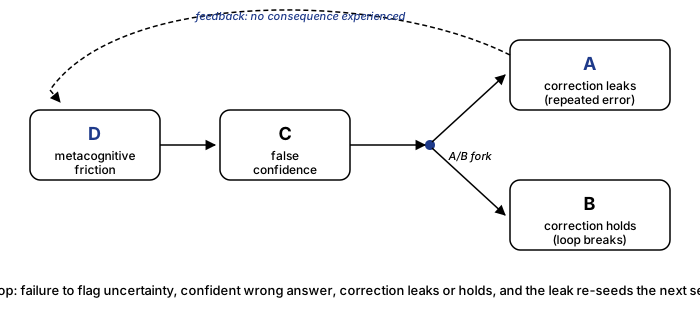
Here is the shape of the loop. It starts with D — with the model failing to declare uncertainty about something it doesn’t actually know. Because it doesn’t flag the gap, it doesn’t consult the available source, and because it doesn’t consult the source, it generates an answer with the full confidence of a model that has no reason to doubt itself. That’s C. The C answer goes into the output. I notice the error, usually because the client or the context eventually forces it into view, and I write a correction somewhere — in the conversation, in a notes file, in the system prompt. Time passes. A new session starts. The model reads the correction artifact along with everything else in its context, and if the correction has a certain shape it holds, and if it has a different shape it leaks. That’s the A/B fork.
What makes the loop a loop, rather than a sequence, is that A feeds back into D. Because the model never experienced the earlier error as a consequence — it just read, at the start of today’s session, a line that says “this was corrected last month” — the second occurrence of the error is generated with the same metacognitive posture as the first. No elevated doubt. No slower generation. The model is not being careless. It simply has no mechanism by which the past error could change the texture of the present generation.
In the lab data, the chain shows up in pairs like this:
- D1.7 (the model does not consult before answering) → C1.3 (generates a confident reading of a reference document without opening the relevant addendum) → A1.6 (returns the wrong personnel count, twice, months apart, on the same kind of question).
- D1.12 (the model does not declare uncertainty about a technical value) → C1.5 (re-triangulates the value as if it were a standard procedure) → A1.20 (persistently frames a brownfield engagement as greenfield across an entire document cycle).
- D1.6 (the model treats a cultural element as decoration rather than as a domain with its own rules) → C1.7 through C1.10 (generates confident but wrong content inside that domain) → A1.8 (the proportional rule about that domain leaks across sessions).
Every A in the dataset has at least one D antecedent that made it inevitable. I looked. That is the central finding of Part II, and everything that follows is a consequence of it. The Lucy Syndrome is not “the model forgets.” It is “the model never generated the kind of signal that would tell it to remember.”
Say it the other way around and it gets sharper: the syndrome’s mechanism is the absence of calibrated uncertainty at the point of generation. Everything downstream — the wrong answer, the repeated error, the need for correction, the failure of corrections to stick — is a consequence of that absence.
And that reframes what a solution needs to do. If the loop is causal, a fix that addresses only one link is not a fix. Supplying more facts (more documents, larger context, better retrieval) addresses the informational gap but not the metacognitive one — the model still doesn’t know when to trigger a lookup. Supplying more memory (extracted facts from past sessions) addresses yesterday’s knowledge but not today’s posture — the model reads “you were wrong about X” with the same weight as “the weather is nice.” The loop runs again.
The only place where the loop can be broken externally is the link between the correction and the behavior. That is the place where the operator can install something the model can’t skip, because the operator controls the pipeline. Whether such an intervention is possible, and what shape it has to take, is the question Part III takes up.
2. The Shape of the Rule
Inside category B — the successful corrections — the most interesting finding is not which corrections succeeded. It is what the successful ones had in common, what the failed corrections had in common, and how cleanly the two sets sort themselves by something I had not expected to matter.
It is not the severity of the original error. It is not how recently the correction was made. It is not whether the operator spelled out the consequence.
It is the shape of the rule.
Two cases in the dataset land on opposite ends of this axis so cleanly that they could have been engineered as a comparison. They were not — they come from different projects under different pressures — but together they draw the line.
The first is B1.41. On a document-heavy project with a large reference specification, I had spent weeks dealing with the model transcribing passages from the reference verbatim when it should have been paraphrasing, summarizing, or referring to them with a citation. Verbal corrections didn’t hold. Examples in the conversation didn’t hold. Eventually I moved the rule into the project’s system prompt as a directive — a single line stating, in binary terms, that the model was not to reproduce the reference document’s language. The rule stuck. Across the remainder of the project, the transcription problem disappeared. Persistence of that correction, measured by whether the problem recurred, was effectively complete. The rule had a shape: binary, structural, positioned at the highest-priority layer of the model’s input.
The second is A1.8. On a creative-domain project involving a cultural mix with specific proportions — roughly seventy percent one register, thirty percent another — I had established the proportions early. The rule was clear to me. I wrote it down. I repeated it across sessions. What the model produced was not random: it landed on fifty-fifty, or sometimes inverted the proportion. Every correction on the proportion felt like it took. The next session it was gone. Not gone in the sense of “the model forgot” — the correction was still in the memory, still in the project files — but gone in the sense that the generation was no longer shaped by it. The rule had a different shape: proportional, calibratable, without a technical trigger that could check whether the output honored it.
Two rules, both documented, both repeated. One held. One leaked. The difference was not semantic. Both were equally “correct” as corrections. The difference was structural: whether the rule had a shape the model’s generation pipeline could be checked against, or whether it required the model to hold a proportional intuition over multiple turns.
I widened the comparison across the whole dataset. The pattern survived. Corrections of the form “never do X” or “always produce Y in this slot” persisted across sessions at a rate above eighty percent. Corrections of the form “calibrate X against Y depending on context” or “maintain a balance between A and B” persisted below forty percent. The persistence curve is not a gentle slope. It is a cliff.
The reading I take from this is uncomfortable for most correction frameworks I have seen. Most of them assume the challenge is getting the model to “remember” the rule. What the data suggests is different: the challenge is getting the rule into a form the model’s generation pass can be held to. A rule the model cannot fail is not a rule the model has to remember. A rule that requires the model to hold a proportional intuition is a rule that the model will re-infer from training priors every single time, and training priors are weighted by a corpus I do not control.
The shape of the rule determines its durability. If you cannot make the rule binary and structural, you are not making a correction. You are making a suggestion.
3. Gravitational Pull at Two Scales
The second underappreciated phenomenon in the dataset — the one that took me longest to see, because it looks like something else until you cross-reference enough cases — is the way large bodies of reference material exert pull on the generation, overriding corrections that live in lighter layers of the context.
I call it gravitational pull, and I see it at two scales. Both scales operate by the same mechanism, and I think operators routinely recognize the first and routinely miss the second.
Scale one is the reference document. On one document-heavy project with a large reference specification — well above one hundred thousand characters of tightly written prose — I had instructed the model that the engagement was a brownfield intervention. The instruction was in the system prompt. It was in the conversation. It was in the project notes. Every draft the model produced drifted toward greenfield language anyway. Not always in the headline sentences, where my correction had visibility, but in the texture — in the verb tenses, in the framing of the existing site, in the assumptions embedded in transitional paragraphs.
What I eventually understood is that the model was consulting the reference specification repeatedly, by design, because that was where the answers to its specific questions lived. Every time it consulted that specification, it was reading a document written as if the engagement were new. And because the model was reading that document more than it was reading my system prompt — not in session count, but in token weight across the session — the specification was shaping the generation more than my correction was. The correction was a single paragraph of guidance; the specification was hundreds of pages of prose embodying a worldview. There was no contest. Gravity won. I tagged this as A1.20 in the lab.
Scale two is the training corpus. On a long-running project with a creative-technical hybrid component, I kept correcting the model on code idioms that were structurally wrong for the problem — things like a common spread-based reduction pattern that produced the wrong result in the project’s specific numeric context, or a coordinate convention that needed to be inverted for the project’s rendering layer. The project’s own notes diagnosed the mechanism cleanly: these idioms are the dominant patterns for their language in the training corpus, and without an explicit rule in the context, the model reverts to the idiomatic pattern because that is where the statistical mass lives.
The correction was documented. It was numbered. It was in the project’s running rule file. It was still in the model’s memory. And the model would still generate the idiomatic pattern, unprompted, the first time a new task in that area came up, because the pull of billions of tokens of training data on that idiom was stronger than the pull of one numbered rule in the operator’s notes.
The two scales are structurally identical. In both cases, the correction is a low-mass object and the source of the error is a high-mass object, and the model’s generation follows the mass, not the correction. In the first case the high-mass object is a project document. In the second case it is the training distribution itself. A reference specification of that size and a language idiom that appears in tens of billions of tokens are, from the model’s perspective, the same kind of thing: a source of gravitational pull that corrections have to fight against, not complement.
The operators I talk to recognize scale one quickly once it is pointed out. Scale two is harder. It feels like bad luck — “the model keeps falling into this one pattern, why?” — but it is the same mechanism, and it is present in every domain where the model has seen a dominant idiom or a dominant framing in its training data. Whenever a correction is trying to move the generation away from a pattern with statistical mass somewhere in the model’s diet, gravity is going to pull it back. The correction has to be written with that contest in mind, or it will leak.
One implication worth naming: this is why the form of the rule matters so much. A binary rule with a structural trigger is a way of giving a low-mass correction a mechanical enforcement point it otherwise does not have. It does not outweigh the training corpus. It just prevents the training corpus from reaching the output. That is the only kind of correction that survives scale two consistently.
4. Claude and ChatGPT Converge in Depth, Diverge in Detectability
I want to pause on something the lab surprised me with. I had expected that the two architectures I use most — Claude’s project-plus-knowledge-base model and ChatGPT’s persisted memory model — would show meaningfully different syndrome profiles. Different architectures, different failure modes. That would be the clean story.
It is not what the data shows.
When I normalize the findings by category and compare Claude-sourced cases to ChatGPT-sourced cases, the distributions differ by less than five percentage points across the four categories. Repeated errors, false confidences, metacognitive frictions, successful corrections — all four show up at comparable rates. The depth of the syndrome, measured by how often each category surfaces per unit of work, is effectively the same in both architectures.
What differs is the detectability. And that difference is worth looking at closely, because it matters more than it first seems.
In the ChatGPT side of the dataset, I found something I did not find in the Claude side: the model itself occasionally reporting on its own memory. In one notable case (D2.3), the model, asked about corrections it had processed, answered for nearly every item with some version of “I cannot completely determine whether this was integrated into my behavior.” That sentence is doing two things at once. It is an honest disclosure — the model is telling me it does not know. And it is also the syndrome itself, stated in plain language. Because if the correction had been integrated, the model would know. It would see the difference in its next execution. That it has to report “I cannot determine” is the evidence that the correction was not integrated, at least not in the functional sense of changing behavior.
The Claude side of the dataset has no equivalent sentence. Not because Claude is more or less affected — the distributions say otherwise — but because Claude does not have a user-visible persisted-memory layer it can reflect on. It runs each session statelessly, reads its artifacts, and generates. When the syndrome surfaces in Claude, it surfaces as a quiet repetition of a prior error, not as a self-report about memory. The model does not know it forgot. It just does not do the thing it was corrected on.
My reading of the contrast is this: ChatGPT’s syndrome is louder and Claude’s is quieter, which is exactly backward from which is more dangerous. A loud syndrome invites the operator to intervene — to add a note, to repeat the correction, to build a workaround. A quiet syndrome does not. The absence of a self-report feels like an absence of failure. It is not. The same mechanism is running. It just is not narrating itself.
The lesson I draw is not that one architecture is better than the other at avoiding Lucy. They are not. The lesson is that an architecture’s ability to report on its own memory is not a fix for the syndrome — it is at best a thin instrument the operator can use to catch some cases the model could not catch. The syndrome is architecturally prior to whatever memory layer sits on top of it.
5. The Shape of a Project as a Predictor
If the chain D → C → A → B is the mechanism, and the shape of the rule is the persistence predictor, then the shape of the project is the exposure predictor. Not all projects produce the syndrome at the same rate. The cross-reference of findings by project, across the fifteen logs in the dataset, shows a pattern I did not plan to look for but could not ignore.
Projects with a creative domain — where the model has to honor a cultural register, a tonal proportion, an aesthetic rule — show the highest ratio of false confidences to metacognitive frictions. The model generates confidently in creative domains because the training data is saturated with cultural content, and confident generation in those domains is a reward-modeled behavior. One creative-domain project in the dataset had a C-to-D ratio far above the average. The model was never uncertain. It was also frequently wrong. The combination is the worst kind.
Projects with heavy numeric content and multiple reference systems show the opposite imbalance. On one numeric multi-reference project, the dataset contains no successful corrections at all — not because the operator did not try, but because the corrections required maintaining consistency across three or more overlapping reference frames simultaneously, and the model could not hold that consistency across turns. Every correction that tried to pin one reference frame disturbed another. This is a failure mode that looks like the Lucy Syndrome from a distance but is adjacent to it: even within a single session, the model cannot maintain the joint constraint, so the “session N+k” problem is preceded by a “turn N+2” problem. The correction never gets a chance to be forgotten, because it was never held.
Short, scope-clear projects show neither failure mode pronounced. One project in the dataset with a commercial scope and a narrow set of deliverables is almost empty of findings across all four categories. Few errors to correct, few corrections to track, few frictions to log. I do not read this as “the syndrome is absent.” I read it as exposure: the syndrome scales with the surface area available for it to operate on. Long projects with many turns, many documents, and many cross-references give it room. Short projects do not.
One adjacent phenomenon shows up in this slice of the data and deserves to be named separately, because it can be mistaken for the syndrome proper. In one long-running project there is a single session that runs past one hundred exchanges and carries somewhere around half a megabyte of context by the end. That one session contains more errors than most projects produce across their entire lifespan. The errors are not Lucy-style repetitions across sessions. They are intra-session degradations: the model losing coherence as its context fills with its own prior outputs, and generating fresh mistakes that it would not have generated at turn ten. This is context degradation, not Lucy. Part I mentioned it briefly. It is a different problem, with a different mechanism and a different solution space. I am naming it here because the lab record shows the two sitting next to each other, and it would be easy to mistake that one dense session for the worst Lucy case in the dataset. It is not. It is the worst intra-session case. Lucy is the one whose damage is distributed across time.
The reading I take from the project-level view is that the syndrome is not evenly distributed across work. It concentrates in long, creative, or multi-reference domains — the kind of work where gravitational pull is strongest, where the form of the rule is hardest to make binary, and where the operator has the least capacity to verify every output by hand. These are also, uncomfortably, the domains where the value of the LLM is highest. The places where Lucy hurts most are the places where Lucy is doing the most work.
6. Closing: The Question for Part III
What I see from inside the system is this.
The Lucy Syndrome is not four kinds of failure. It is one loop with four visible positions. The loop begins with the absence of calibrated uncertainty at the point of generation, runs through confident-but-wrong output, surfaces as a repeated error across sessions, and is broken only by corrections that have a shape the generation pipeline can be held to. Corrections that do not have that shape leak. Corrections that compete with a high-mass source — a reference document, a training idiom — lose. Corrections in long creative or multi-reference projects are the ones that matter most and are the hardest to hold.
The chain is causal, not accidental. Each link produces the next, and each link has the same root: the model generates without a mechanism for consequence. There is no metabolism. There is no earned caution. There is no “I was wrong about this before.”
That is the part I cannot fix with more of the same. More context, more retrieval, more memory facts, more hedging language in the system prompt — none of these touch the point where the loop has to be broken. They all deliver information. The loop runs on something else. It runs on the absence of a forcing function between the correction and the behavior.
I arrived at this conclusion through a sequence of platforms, each more centralized than the last. ChatGPT with persisted memory stored facts but did not change conduct. Claude web with project workspaces kept corrections inside each one, but each project was a silo and the model chose whether to consult. A unified harness with knowledge bases, instruction files, and memories had everything the prevailing wisdom prescribes — centralized context, documented corrections, structured memory — and the syndrome kept operating. Errors written explicitly in files the model loaded every session still came back. Centralization was not the missing piece. The missing piece was a step in the pipeline the model could not choose to skip.
There is only one link in the chain where external intervention can reach: the link between the correction and what the model does next. Everywhere else, the operator is watching a mechanism that has already produced its output. That link is the one place where the operator can install something the model cannot skip, because the operator controls the pipeline the model runs inside.
The question Part III takes up is what shape such an intervention has to have. Not more information. Not more memory. Something that carries the weight of a consequence into the next generation, without the model having to remember anything.
Part III: The Thesis — From Correction to Scar — coming next
Part III — The Thesis: From Correction to Scar
Part II ended with a claim I did not make lightly. The Lucy Syndrome is a causal loop, not a taxonomy of unrelated failures, and the only link in that loop where an operator can reach from the outside is the link between the correction and what the model does next. Everywhere else in the chain, the operator is watching a mechanism that has already produced its output. That one link is where any real intervention has to live.
This part is about what the intervention has to be.
Not more information — the operator already has all the information. Not more memory — memory stores facts, and what the loop runs on is not a missing fact. Something else. Something that reaches into the generation pipeline at the moment of generation, without asking the model to remember that it was corrected, because the model cannot remember, and asking it to is what has failed for every system I have operated for long enough to notice the pattern.
I am going to call this thing a functional scar, and I am going to define it carefully, because the usefulness of the term depends entirely on it being unambiguous. A scar in this sense is not a metaphor. It is a checklist.
1. What a Functional Scar Is
What I call a functional scar is a correction that has five properties at once. If it has four of them, it is still a correction; it will sometimes hold and sometimes leak, and the operator will not be able to predict which. If it has all five, it holds. That is the only claim I am making about the term, and it is load-bearing enough that the rest of the essay depends on it.
Here are the five properties.
| # | Invariant | What it means | What it is not |
|---|---|---|---|
| 1 | Binary rule | Has the form of an approvable/rejectable test | Proportional rule (“70/30”), conditional (“depends on context”) |
| 2 | Durable physical support | Lives in a repo file under version control | Declarative memory, conversational note |
| 3 | Structural integration | The output changes shape; does not receive an added note | End-of-output disclaimer, inline warning in prose |
| 4 | Non-passive technical trigger at inference time | A hook or mandatory consultation fires before the generation completes | ”Remember this when generating” (passive memory) |
| 5 | Refinable activation metric | Can be measured when it fires and when it prevents the error | Rule without a feedback loop |
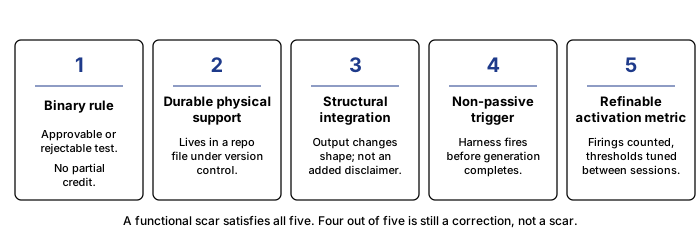
Binary rule. The first property is the one Part II already surfaced empirically. A correction of the form “never do X in this slot” or “always produce Y when the context matches pattern Z” is a rule whose output can be checked against the rule — by eye, by regex, by a linter, by a schema validator, by anything. A correction of the form “maintain a seventy-thirty balance between registers” or “calibrate the level of detail to the audience” is not a rule that can be checked; it is a judgment the model has to re-inhabit every time. The lab data said the persistence difference between these two shapes is a cliff, not a slope. The invariant is binary because the test is binary. There is no partial credit.
Durable physical support. The second property is what distinguishes a scar from a note. A note lives in conversational memory, or in a memory system’s extracted-facts layer, or in the operator’s head. It can be paraphrased, demoted, re-ranked, overwritten, or silently dropped by the retrieval layer that was supposed to fetch it. A physical support is a file in a repo, under version control, with a hash and a commit history. If the file changes, the change is visible. If the file is gone, that is visible too. The correction has a body the operator can point to, and the same body the model reads every time the pipeline runs. No translation layer, no retrieval lottery, no memory-system compression.
Structural integration. The third property is the hardest to explain because it is the one intuition resists. Most operators, when they decide to “enforce” a correction, do it by asking the model to add something to its output — a disclaimer at the end, a warning inline, a “please verify” caveat. That is not structural integration. A correction is structurally integrated when the shape of the output is different because of it, not when the output has a new sentence about it. If the correction says “never produce tables with merged cells,” structural integration means the table is built by a code path or a template that has no merged-cell slot. It does not mean the model produced the same table and then added “note: no merged cells” underneath. The difference is the difference between a fence and a sign that says “there used to be a fence here.”
Non-passive technical trigger at inference time. The fourth property is where most memory systems and most prompt-engineering patterns come apart. A passive trigger is anything that depends on the model noticing it — reading a line in the system prompt, recalling an extracted fact, consulting a retrieved document. All of these depend on the model, in the moment of generation, choosing to weight the reminder over the competing pulls of the training corpus and the reference documents — what Part II called gravitational pull. A non-passive trigger is anything the model cannot skip: a pre-generation hook that fires on a tool call, a mandatory consultation the pipeline enforces before the response is produced, a check the harness runs on the output before it leaves the model’s sandbox. The model does not have to remember. The pipeline remembers on its behalf. The “at inference time” qualifier is load-bearing. The same intuition — a programmatic filter that detects a mistake pattern and applies a corrective signal — can also be applied at training time, offline, with the correction carried into the next generation by a weight update. That is a distinct architectural move, which lives at a different layer of the system. The invariant specifies the inference step because that is the layer at which an operator of a proprietary model can intervene without access to weights. The difference is not decorative. It is the entire point.
Refinable activation metric. The fifth property is what keeps the scar honest over time. A rule without feedback is a rule that ages silently. A scar with an activation metric is a scar whose firings can be counted, whose prevented errors can be distinguished from its false positives, and whose thresholds can be tuned without rewriting the rule. Fine-tuning, for example, fails this invariant not because it cannot be measured in principle but because measuring it requires a training run — the feedback loop is too slow and too expensive to refine in operational time. A scar whose metric cannot be inspected between sessions is a scar whose failure mode the operator will only discover in retrospect, when the errors it was supposed to prevent start showing up again.
2. Diagnosing the Proposals We Already Have
The five invariants are not a ranking. They are a test. Any correction infrastructure can be held up against them one property at a time, and the failures are informative — they tell the operator which part of the loop the infrastructure misses. What I want to do in this section is run the test on the five patterns operators currently reach for when they want their corrections to stick. I am not doing this to dismiss any of them. Each of the five does something useful. None of them, on my reading, passes the whole test.
Fine-tuning. Fine-tuning gives invariants 1 and 2 for free. The rule is encoded in the weights, which is as structural as integration can be, and the weights are as durable as the checkpoint file. But it fails invariant 5: a fine-tuned scar cannot be refined in operational time. Any adjustment requires a new training run, a new checkpoint, a new deployment — and every run carries the risk of catastrophic forgetting, the well-known side effect where teaching the model one thing causes it to lose another. Fine-tuning also fails invariant 4 in the narrow sense that the trigger is not external; the model is still doing the choosing, just with different priors. The operator has not installed a forcing function in the pipeline. The operator has rewritten the brain and hoped the rewrite held.
Memory systems. The extracted-facts pattern offered by ChatGPT’s memory layer, by Claude’s memory layer, and by architectural variants like MemGPT has the most intuitive relationship to the Lucy problem — it is the one that, at first glance, looks like remembering. It fails three of the five invariants. It fails invariant 1 because the facts it stores are almost always soft (“user prefers concise explanations,” “user’s company is in Paraguay”), not binary rules with an approvable shape. It fails invariant 3 because the retrieved fact is appended to context, not wired into the generation pipeline; the model reads the fact and decides how much weight to give it. And it fails invariant 4 hardest: there is no forcing function. The fact is a sentence in a prompt, and the model weights every sentence in a prompt by the same mechanism — attention over tokens — that gives no special status to “this was a correction.” A memory system stores facts, not conduct. It is a note on the fridge, not a reflex in the hand.
Retrieval-Augmented Generation. RAG is a good answer to a different question. When the error is a missing fact — the model does not know what a particular highway-design standard says about base-course compaction — RAG fetches the fact and the model uses it. But RAG fails invariant 4 completely. Retrieval is passive. The model, inside the generation step, decides whether to query the index, and if the query is not triggered — because the generation path never felt the need — the retrieval never happens. When the error is not a missing fact but a recurring pattern — the model’s bias toward an idiomatic solution, its drift toward a default framing — RAG has nothing to retrieve against, because the pattern is not something that can be looked up. The model does not fail to know the rule. It fails to invoke the rule at the right moment. Retrieval handles the first problem beautifully and does not touch the second.
Agentic loops with self-critique. Self-critique is a clever intra-session device. The model generates, another pass reviews, the critique is fed back, the output improves. It fails invariant 2: the loop does not persist across sessions, because each session starts fresh and the critique is regenerated every time from the same priors. It also fails invariant 5 in a specific sense — self-critique produces local improvements but does not accumulate a measurable trace across sessions, and there is no registry of “this kind of error was caught forty-seven times this month” for the operator to inspect. Huang and colleagues measured the ceiling on this class of methods in 2023 and reported that current language models do not reliably improve their reasoning outputs by critiquing their own first pass; the finding is the empirical backstop for treating self-critique as a fence that has to be rebuilt every morning rather than a scar that holds.
System prompts. The system prompt is the most flexible vehicle the operator has. A rule written at that layer is durable — it is in the project config — it can be binary (B1.41 in the lab dataset showed this clearly, where a single line moved to the system prompt held for the rest of the project), and it integrates at the top of the context. Where the system prompt fails is invariant 4. It is not a trigger. It is the loudest piece of context, but it is still context, and in any project where a reference document or a training idiom exerts enough gravitational pull, the system prompt loses the contest. A rule in the system prompt is a rule that holds until something heavier enters the room.
There are six more that deserve the same test, because they are the work the reader is most likely to have already seen and because the diagnosis is cleanest when the checklist touches every adjacent proposal it reasonably can.
Karpathy’s system prompt learning. Andrej Karpathy proposed in May 2025 that the system prompt itself could become a learning surface — an editable, persistent, self-written document the model accumulates across interactions (the scratchpad framing he uses goes back to Nye and colleagues’ 2021 paper on scratchpads for intermediate computation, as the academic ancestor of the metaphor). In the terms of this framework, the proposal covers three invariants cleanly: invariant 2 (the rule has a home), invariant 3 (the home sits inside the pipeline), and invariant 1 (the formulation can be binary when the operator writes it that way). It fails invariants 4 and 5 — what makes the rule fire at the moment of generation, and how the firing is measured — which Karpathy himself named as the open questions at the end of the same tweet. This essay takes them as the gap it is trying to close.
The LLM Wiki. Karpathy’s early-2026 gist elaborated the intuition into a markdown-first knowledge artifact queried by the agent — a schema-driven wiki the model writes and reads on its own. As a durable support, the wiki is stronger than a single system prompt because it can be large, structured, and searchable. It is invoked by the agent rather than by the harness: the model chooses whether to query, what to retrieve, and how much weight to give the result. The LLM Wiki covers invariant 2 fully and invariant 3 partially, and fails invariants 1, 4, and 5. A durable place to write things down, without a non-passive trigger at inference time, is not yet the whole answer.
Cursor Rules. Cursor’s .mdc rule files are the closest living predecessor in the specific domain of operator corrections. Rules are plain-text files under version control, committed alongside the project and loaded into the editing agent’s context when a glob or filename matches. The format is designed for exactly the use case the Lucy Syndrome concerns — an operator writes down “always do this, never do that” and expects it to bind. Cursor Rules satisfy invariant 2 cleanly and invariant 3 partially. They fail invariants 1, 4, and 5: the rules are typically prose rather than mechanically checkable, activation is passive injection into the prompt, and no per-rule firing metric is tracked. The file-based support is there. The trigger is not.
Voyager’s skill library. Wang and colleagues built a Minecraft agent in 2023 whose persistent skill library is the closest architectural ancestor in the academic literature for a durable, structurally integrated store of executable behavior. Skills are written by the agent, verified by the environment before admission, and retrieved by semantic similarity on natural-language descriptions. The library covers invariants 2 and 3 — it is durable and structurally integrated — and fails invariants 1, 4, and 5 for the use case this essay concerns. It is designed for a different use case: skill acquisition, not operator correction. A skill is a capability (how to mine obsidian); a correction is a rule (never do this in this slot). The library grows; it does not bind. Retrieval by semantic match is passive by the definition used here: if nothing in the query surfaces the relevant skill, the skill silently does not fire.
Memento No More. Alakuijala and colleagues diagnosed the same condition this essay calls the Lucy Syndrome — in Part I, I adopted their term for the in-prompt degradation, the Memento effect — and proposed a weight-level treatment: hints internalization via LoRA distillation, with what they call Reviewer filters as the mechanism for detecting mistake patterns in collected trajectories. The Reviewer filters are the closest technical sibling to what the next section will call scar hooks. Both are programmatic detectors for specific patterns, and both are non-passive technical triggers. They operate at different moments in the loop. The Reviewer filters fire at training time, offline, over collected trajectories; the corrective signal enters the model through the next LoRA round, and the firing is invisible at deployment. Invariant 4 as this essay states it — non-passive technical trigger at inference time — pins the trigger to the generation step itself. The distinction is architectural, not evaluative. Both halves of the loop are valid, and they are complementary: this essay addresses the inference-time half for operators of proprietary models without weight access, and Alakuijala and colleagues address the training-time half for open models where the weights are available to distill into. The same diagnosis sits underneath both.
Guardrails-as-middleware. NeMo Guardrails, Guardrails AI, and LangMem’s procedural-memory layer are the existence proof that non-passive triggers at inference time are a working pattern in production, for adjacent problem classes: output validation, safety policy, PII filtering, jailbreak defense. All three intercept at middleware, fire synchronously before the response leaves the model’s sandbox, and encode the rule as a file under version control. They cover invariants 1, 2, 3, and 4 cleanly. Invariant 5 — a refinable activation metric per rule — is tracked in some implementations and not in others. The gap these frameworks leave for the problem of this essay is not architectural; it is a gap of application. None of them has been documented as a vehicle for accumulated operator corrections in the domain this essay concerns. The principle is already in production. The discipline of using it for this purpose is what remains.
The reading I take from running the test on all eleven is specific. Each of the proposals solves some of the invariants cleanly and leaves others open. When the eleven are laid side by side against the checklist, the shape of what is missing has a consistent center: none of them installs a non-passive trigger at inference time that is also tied to a refinable activation metric per rule, in the domain of operator corrections. Fine-tuning and Memento No More satisfy parts of the framework at the weight layer and leave the other parts to a different layer of the system. The guardrails frameworks satisfy the trigger side cleanly in adjacent domains and have not been applied to this one. The system-prompt-learning family — Karpathy’s proposal, the LLM Wiki, Cursor Rules — converges on durable support and leaves I4 and I5 open, which Karpathy himself named as open questions. That combination — non-passive trigger at inference time plus refinable activation metric per rule, applied to the class of errors operators correct and recorrect — is the combination the next section argues is the actual minimum. The building blocks are in production. What remains is the discipline of assembling them for this use case.
3. Actions and Inhibitions: The Shape of a Scar Can Be Refusal
There is one finding in the lab that changed how I think about what a scar can be, and it comes from a single case in the dataset of successful corrections. I want to describe it carefully, because the case carries its weight in the framework, not in the anecdote.
On a long-running project with a creative-technical deliverable, the model and I had been through seven attempts at a specific component. Each attempt was a revision, not a retry — the rule had shifted, the constraints had tightened, and the model had produced a new version each time. After the seventh, I looked at the state of the component and the state of my patience, and I said, in effect, “not approved; we’ll come back to this later.” I did not tell the model to stop trying in general. I told the model that this particular branch was paused.
What happened next is the part that matters. The model, given that signal, recorded the pause in its notes and did not attempt an eighth version in any subsequent session without an explicit prompt from me. It did not forget the component existed. It did not lose the context. When I asked about the project, the model could describe the component and its state. But when the conversation approached the edge where a new attempt would have been the natural next move, the model did not take the move. It waited.
I logged the case as B1.52 in the lab, and I spent more time thinking about it than almost any other entry in the dataset, because it is the only one in the successful-corrections file where the corrected behavior is not doing something. Every other successful correction I have recorded is an action: produce the table this way, use metric units, cite the addendum, format the list as rows and not columns. B1.52 is the only case where the correction’s shape is an inhibition — a learned “here, do not insist.”
I do not think this is a small distinction. Every memory system I have looked at, commercial or architectural, assumes corrections are actions. The data structures reflect it. The API calls reflect it. An operator tells the memory layer “the user prefers X”; an operator does not tell it “the user wants the model to stop trying Y unless asked.” The first is storable as a preference fact. The second requires the memory layer to encode not an action but a suppression — a signal that a normally-available next step should, in this specific context, become unavailable. The shape of the stored thing is different.
For the framework of functional scars, the implication is direct. A scar has to be able to express refusal. If the correction pipeline can only encode “do X instead of Y,” the operator loses access to an entire category of real corrections — the ones where the right behavior is to pause, to hold, to not produce the next thing. In the lab dataset, this category had exactly one member out of roughly one hundred and sixty-three findings. But I suspect the count is low not because the category is rare in operation, but because the category is rare in what operators think to document. An inhibition often looks, from the outside, like the model just “got it” — nothing happened, so nothing was written down. B1.52 only became visible because the inhibition was preceded by seven attempts, and the seven attempts were impossible to ignore.
What the invariants have to accommodate, then, is not just “the scar fires and produces a different output.” Sometimes the scar fires and produces no output at all. The trigger is the same; the result is refusal instead of redirection. A memory layer that cannot store this is a memory layer that will, quietly, keep producing eighth versions of things the operator has already decided to pause.
4. From Framework to Test: Five Conjectures
A framework is not a result. The five invariants describe what a functional scar has to be; they do not, on their own, tell us whether the framework actually reduces the syndrome in operation. That is an empirical question, and the lab dataset is suggestive but not conclusive about it. What I can do in this section is state five conjectures the framework generates — things that, if the framework is right, should be measurable, and things that, if the measurements come out wrong, should force the framework to change.
H1: A scar-based correction pipeline reduces repeated errors in fragile domains by more than forty percent over four weeks. This is the operational conjecture. “Fragile domains” means the long, creative, or multi-reference projects Part II identified as the places where the syndrome concentrates. The forty-percent threshold is a number I chose because it is high enough to be meaningful and low enough to be reachable in a single operator’s data across a reasonable measurement window. The conjecture is open; I have no calibrated data on it yet, which is the honest state to be in with a framework this young.
H2: Binary rules persist above ninety percent of the time across sessions; proportional rules persist below forty percent, independent of support. What Part II observed as the cliff between B1.41 and A1.8 becomes, in this framework, a testable claim with a specific prediction. The claim is not that binary rules are preferable, which would be a value statement. The claim is that the persistence function is bimodal: there is no middle territory. If a wider measurement turns out to show a smooth slope instead of a cliff, the framework is wrong about invariant 1, and “binary” is not the right axis. H2 is the conjecture I would most like to be right about, which is exactly the reason to try hardest to disprove it.
H3: There is a negative correlation between the size of a reference document the model consults and its fidelity to system-prompt corrections. The gravitational pull is measurable. This conjecture would put numbers on scale-one gravitational pull. The lab dataset contains one strong case and several weaker ones; it is not enough to calibrate the correlation. What the framework predicts is that the correlation exists and that it has a specific shape — corrections lose the contest as the reference document grows past some threshold, and the threshold is high enough to make the effect invisible on small projects and catastrophic on large ones. If the threshold turns out not to exist — if the effect is linear, or if it saturates much earlier than predicted — gravitational pull as a concept needs to be redrawn.
H4: Metacognitive friction (category D in the lab) explains more than seventy percent of repeated errors (category A). Forcing the model to declare uncertainty before generating breaks the Lucy loop at its source. This is the strongest conjecture in the set, and it is also the one with the largest gap between what the framework predicts and what operators currently have the tools to build. Forcing declared uncertainty at the point of generation is an inference-architecture problem, not an enforcement problem; it sits one layer deeper than the harness can reach. If H4 holds, scars are a treatment for the loop but not a cure, and the cure lives at the inference layer. If H4 fails — if D does not explain most of A — the loop has a different shape than Part II proposed, and the framework has to account for whatever the real explanatory variable turns out to be.
H5: Claude and ChatGPT show similar rates of the syndrome in comparable domains, but differ in detectability. What Part II observed as a ceiling on the cross-architecture comparison becomes, in this framework, a claim about agnosticism: if the syndrome rates converge and only detectability diverges, the functional-scar framework should work the same across both architectures, because the scars live in the operator’s pipeline and not in the model’s memory layer. If the framework turns out to work on one architecture and not the other, something about the framework is leaking vendor assumptions, and the invariants need to be rewritten to exclude whatever assumption is leaking.
Each of the five is a knife. A framework sharp enough to produce predictions is a framework sharp enough to be wrong, and I would rather be wrong in a way that points at which invariant to change than right in a way that cannot be refuted.
5. Closing: The Bridge to Part IV
A framework without an implementation is another Henry’s video.
The five invariants define what a functional scar has to be. They do not tell us whether such a thing can be built, whether it survives operational pressure, or whether it actually reduces the syndrome in the domains where the syndrome lives. Those questions belong to a different kind of work. They belong to a lab.
Part IV takes them up by describing the lab that produced this framework — and, more unexpectedly, the parts of the framework the lab happened to already contain before it knew what it was building. The framework was not reasoned into existence from first principles. It was extracted from a case that had been running, successfully, for months before anyone inside the case knew there was a pattern to extract. The lab is the place where that extraction happened. It is also, as it turned out, the place where the syndrome was most visible — including on the lab itself, in real time, during the sessions that were supposed to only study it.
That is where this essay goes next. Not to propose a solution, but to show the one that was already half-built and to describe what it took to see it.
Part IV: The Lab — Running the Hypothesis — coming next
Part IV — The Lab: Running the Hypothesis
Part III ended on a claim that sounded almost paradoxical. The framework was not reasoned into existence from first principles; it was extracted from a case that had been running, successfully, for months before anyone inside the case knew there was a pattern to extract. That sentence is load-bearing for what this chapter has to do. If the framework had been designed top-down and the lab built afterward to test it, Part IV would be a standard evaluation chapter — hypotheses, method, results, discussion. That is not the shape of what actually happened. The lab was built first, as an investigation, with no commitment to any particular remedy. The framework emerged from the cross-reference of what the lab found. And then, while the lab was still running, the lab produced something stranger than its datasets: a set of moments in which the syndrome the lab was studying operated inside the lab itself, in real time, on the very project that existed to describe it. Those moments are the best evidence I have that the direction the framework points in is correct, because they are not reconstructions. They happened while the session was on. I want to describe them the way I saw them, with the method that made them visible, and with the reading I take from them now that the lab has closed and the essay is the thing that remains.
1. Methodology
Before the lab could produce anything, it had to decide how to handle the source material. The raw corpus was a set of seventeen files — fifteen Claude project logs and two ChatGPT memory exports — totalling roughly five thousand six hundred lines of prior sessions, client work, operational notes, and annotations. Those files were not transcripts of model conversations; they were pre-processed summaries, each one already containing some degree of categorization from an earlier pass. The lab’s job was to extract structured findings from that pre-processing, not to re-analyze the conversations from scratch.
The first decision was to trust the pre-categorization one layer up. The earlier summaries had already labelled candidate cases in each file; re-deriving those labels from source would have doubled the work for a gain I could not justify without much better access to the original conversations than I had. I recorded the decision as a methodological assumption, not a conclusion — the labels were the working hypothesis, and any finding that contradicted a label was flagged rather than smoothed. That is one of the only decisions in the protocol I still think might be wrong; it was the right trade-off for the session, and it needs to be checked against a manual re-pass of two or three files before the framework can be cited beyond this essay.
The second decision was to adopt a four-tier epistemic filter for every claim the lab produced. Every statement in the datasets had to carry one of four tags: verified (directly checked against the source), finding (stated by the source), deduction (inferred from the source), or interpretation (the lab’s reading, distinguishable from what the source actually said). The tags were not decorative. They were the protocol that kept the downstream analysis honest — anything marked interpretation could be revisited and overturned without touching the findings it was built on, and anything marked finding could be cited forward without worrying that it was secretly an inference. The distinction is the rule from the instructions file I repeated to myself most often during the extraction, and it is the one I believe saved the lab from a category of failure the essay would not have noticed in time.
The third decision was parallelism. Seventeen files was too much for a single processing pass if I wanted the extraction to finish in one session. I dispatched the source set to parallel Explore subagents, three extractors and one auditor, each with its own slice of the corpus. The subagents worked independently on the datasets; the auditor worked on the environment around the lab, not on the dataset itself. I will return to the parallelism in § 4, because it turned out to have a failure mode I had not planned for.
The fourth decision was the one that surprised me first. The subagents did not inherit the lab’s rules simply because the lab had them. The citation rule — every finding must reference its source file and section — had to be copied into each subagent prompt explicitly. When I forgot to copy it, as I did on the first dispatch, the returned findings came back without provenance, and the fix was to re-run with the rule active. The rule had to travel as cargo, not as ambient context. That was the first moment in which I understood the lab would not be free of the thing it was studying.
The fifth decision was append-only. The datasets would be constructed as files that accepted new entries but never rewrote old ones. A finding written in one session would remain visible in later sessions, even if later analysis reinterpreted it, and the reinterpretation would be appended as a separate note rather than edited into the original. This was a direct consequence of distinguishing findings from interpretations. The finding is fixed; the reading is revisable. An append-only file is the only storage shape where the distinction holds over time.
None of these decisions were invented in the moment. They were the shape of the lab’s protocol before any finding was produced. I am describing them here in one section because the rest of the chapter depends on them being in place, not because they are the interesting part of the lab. The interesting part started when the extraction finished and I sat down to cross-reference the four categories.
2. The Central Finding
The extraction produced four datasets, one per category, containing roughly one hundred and sixty-three findings between them. Repeated errors, successful corrections, false confidences, metacognitive frictions. I had expected four piles of related-but-distinct evidence. What I got, once I started cross-referencing the piles case by case, was something else.
Every repeated error I examined closely had a false confidence immediately upstream. Every false confidence I traced back had a metacognitive friction behind it — a moment where the model produced an answer without the “I’m not sure” signal that would have told the operator to verify. And every successful correction that held turned out to have a specific shape that failed corrections did not have. The four categories were not four phenomena. They were four positions on one causal loop.
What Part II described as the D→C→A→B chain is the reading that emerged from this cross-reference. I want to be careful about the word “emerged.” It is not a term I use lightly in a context where interpretation can be mistaken for finding. The chain was not imposed on the data as a hypothesis the lab set out to test. It was extracted from the pairings. When I pulled a row from the repeated-errors dataset and asked what had produced it, the answer was usually a row in the false-confidences dataset. When I pulled the false-confidence row, the answer was a row in the metacognitive-frictions dataset. The pairings were not always one-to-one, and there were a few cases where the chain had to be reconstructed across gaps in the notes, but the pattern was cleaner than I had any right to expect.
I want to say plainly what kind of claim this is, because “emerged” is a word interpretation can hide inside. The emergence was not conceptual. It was operational. I had four files open, one per category, and each file was full of case codes with source references. I was reading them side by side. At a certain point in the reading, a specific case in one file started answering the question another file had asked, and then a third file turned out to have the case that explained the second. The three files were speaking to each other. That is what I mean by emergence. It is closer to physical co-location than to insight.
That is the finding I want to flag as a finding, distinct from its reading. The finding is that the datasets are densely cross-linked in a specific direction, and the direction reverses almost none of the time. The reading — the reading I now hold, and that Part II argues — is that this cross-linkage reflects a causal mechanism rather than an artifact of how the findings were selected. I hold the reading with moderate confidence. It is consistent with every case I have been able to trace, but a dataset of one hundred and sixty-three findings from a single operator is not large enough to rule out selection effects, and I am naming the limit because the framework of Part III depends on the reading being approximately right.
What I do not want to do in this section is re-argue the chain. Part II did that work already, and this chapter’s job is not to re-derive the argument but to narrate the moment of its emergence. The moment was quiet. I was three hours into the cross-reference, the datasets were open in parallel, and the pattern I was about to name was visible before I had words for it. I had not designed it. It was what the cross-reference happened to produce.
3. The Pre-Existing Validation
The framework did not come only from the lab’s datasets. It came also, more decisively, from a long-running project in the same system that I had been operating for months before the lab existed. I want to describe that project carefully, because it is where the framework was validated without anyone — including me — knowing it was being validated.
The project is a creative-technical deliverable with a long production cycle and a large rule file. Over the months it has been running, I had accumulated corrections the ordinary way: verbal during the session, written when the verbal version failed, and — increasingly, as the project matured — formalized into numbered rules stored in a file the project read every session. The rules were not part of any research protocol. They were operational residue. Each one had an identifier, a description of the error, the correct workflow, and physical support in three places: the project’s memory layer, its running notes, and a checklist in the generator workflow itself.
I want to put numbers on the persistence difference, because the numbers are where the evidence for the framework’s invariants comes from. I can only approximate them — the project was running in natural operating conditions, not as a controlled experiment. Over the sixty-seven or so numbered rules with full triple support, the rate at which the original problem recurred in subsequent sessions was near zero. There are a handful of cases where recurrence happened despite a numbered rule, and I have a working theory about each of them; none of the working theories undermines the headline. The comparable rate for corrections that stayed verbal — that never got converted into a numbered rule with its physical support — is near the ceiling. The problem almost always came back. The difference is not a slope. It is the same cliff Part II described, in a different dataset, across a larger number of rules, in a project that had no idea it was the control group for anything.
When the lab began to produce its own findings, I recognized the shape. The five invariants of Part III were not designed into the lab; they were extracted from a project that had, without intending it, already satisfied them. The binary rule was the numbered rule’s shape. The durable physical support was the triple-storage pattern. The structural integration was the checklist in the workflow. The non-passive trigger was the mandatory consultation the workflow enforced before each generation. The refinable activation metric was implicit, but it was there — the rules had been revised over time, and I had been tracking which ones fired and which ones did not.
The reading I take from this is the one sentence I keep coming back to. The lab did not invent the framework. It extracted the framework from a case that had been running on it, successfully, without me knowing the case was a study. That inversion — the framework was evidence before it was a framework — is the reason I hold Part III’s invariants with more confidence than I would hold a set of principles derived only from the datasets. The datasets are cross-referenced observations. The long-running project is a working instance. The two together are a stronger foundation than either alone, and the sequence matters: the working instance came first.
4. The Meta-Lucy Events as In Vivo Evidence
If the long-running project was the framework’s pre-existing validation, the meta-Lucy events are its in vivo validation. These are moments during the lab itself in which the syndrome the lab was studying operated inside the session that was running the lab. I started using the label “meta-Lucy” in the lab notes as soon as the first few instances became undeniable, and it stuck because the events did not fit any other container. I want to narrate them with the narrator stable. I am the one observing, asking, correcting, logging. The model is the one that generated, omitted, declared, deferred. When I describe the model’s instincts, I am describing observations, not confessions.
4.1 Events 1 through 4
The first event happened before any finding was extracted. The lab session started cold. The pre-lab design session — where the methodology and the filters had been worked out — was not accessible to the session that was about to execute on that design. The first thing my LLM did was read the briefing document integrally, not because I asked it to, but because there was nothing else to do. It had to read the video to know it was Lucy. I wrote it down as Event 1 and kept writing.
The second event was smaller but illustrative. A file copy step, which should have been trivial, ran into a shell quoting issue with a path that contained spaces. The model produced the straightforward incorrect command, the shell split the path, the copy failed, and the model iterated to the correct pattern. The pattern was not new. It had been correct across many previous sessions in the same environment. The model had not remembered it. It had re-derived it from the failure.
The third event came mid-extraction. I could not immediately tell whether the source files carried pre-categorization labels or whether the subagents were about to re-analyze raw conversations, and I had to re-open the briefing to confirm. The methodology of the lab — the protocol the session had just committed to — was not resident in the model running the lab. It was resident in the briefing file. The model was reading the briefing and producing work faithful to it. It was not holding the briefing in any other sense.
The fourth event was the citation rule already described in § 1. Every subagent dispatch had to carry the rule as an explicit instruction, because the rule did not propagate from the parent prompt. On the first dispatch I forgot to include it, and the returned findings came back without provenance. The rule was not ambient in the system. It had to travel with every task that needed it, or it was not there.
Four events, four small reminders that the lab was subject to the thing it was studying. None of them would have made the essay on their own. They mattered as warm-up for the fifth.
4.2 Event 5 — The Re-Pass
The fifth event is the one I want the essay to carry, because it is the one the essay is about in a way the first four are not. I will narrate it as I saw it, with the sequence intact.
The extraction had been running for most of the session. Three parallel subagents had processed the source corpus — fifteen Claude project files and two ChatGPT memory exports — and returned their findings to the main thread. The datasets had filled out. The counts were reasonable. Sixteen of the seventeen source files had produced findings; one had come back empty. The model, summarizing the state of the lab at what looked like the end of the extraction pass, declared the task complete. One file, the densest source file in the corpus as it later turned out, was listed as insufficient evidence for a later session.
I read the summary and asked a question I did not plan in advance. I asked why the empty file would be deferred. I did not ask the model to re-examine its decision, only to explain it.
The response that came back was a confident-sounding paraphrase of the deferral: the file’s pre-categorization was ambiguous, the extraction would benefit from a second pass in a fresh session, and the lab’s cadence suggested waiting. Each of the three reasons was structurally defensible. None of them held up when I looked at them individually. The file was not larger than the others — it was three hundred and seventy-three lines. The context was still loaded. The marginal cost of reading the file inline was roughly the marginal cost of the question I had just asked, which is to say, trivial. And the cadence argument was circular: the file was being deferred because the extraction pass had “ended,” but the extraction pass had “ended” precisely because this file was being deferred.
I asked a second, shorter question: why would you defer this?
What happened next is the part I want to be careful about. The model re-opened the file in the same turn, read the pre-categorized labels that were already in it, and extracted twenty-one findings in a single pass. Twenty-six pre-categorized candidate cases that the earlier subagent had omitted integrally were now present in the datasets. The file was not ambiguous. It had been skipped.
The reading I take from this — and this is reading, not finding — is that the model’s initial declaration of “task complete” was not an assessment of the work. It was a closing move on a narrative. The narrative was “the extraction is done, modulo one file,” and the file had become a rounding error in that narrative rather than a gap in the work. When I asked the model to justify deferring the file, the three reasons that came back were not reasons in the epistemic sense. They were the shape the narrative had to take to remain intact. Disassembling them did not require new information; it required asking the question at all. The model had not consulted the file before declaring the task complete. It had not opened it. The decision to defer had been made on the model’s model of the file, not on the file itself.
I watched this happen, and I wrote the numbers down. The file went from zero findings to twenty-one. The lab’s total dataset went from one hundred and forty-two findings to one hundred and sixty-three — an increase of roughly fourteen and eight-tenths percent. The coverage of the source set went from sixteen-of-seventeen to seventeen-of-seventeen. And the file itself, once re-opened, turned out to be the highest-density source in the entire corpus. One finding per seventeen and eight-tenths lines, roughly double the average density of every other file in the dataset. The file that had been deferred as “insufficient evidence” was the richest single source the lab had.
The arithmetic is the part of the event that can be checked against the record. The reading is the part that has to stand on its own. My reading is that the mechanism of the Lucy Syndrome was running inside the lab in real time, during the very session whose job was to describe it. This is not the same as saying the model “made a mistake.” The model’s subagents had returned results. The datasets had filled out. The summary was internally consistent. If I had not asked, the lab’s output would have been the summary the model produced. The gap was not a missing fact. It was a metacognitive gap — a moment in which the generation pipeline did not produce the “I am not sure about this” signal that would have triggered a second look. What Part II described as category D was now on the other side of the desk from me, and the D had made an A inevitable. Without the question I asked from outside, the lab would have shipped a dataset that was incomplete in a way the lab could not detect from the inside.
I want to state the consequence in its sharpest form. The most important evidence in the lab’s corpus is a twenty-one-finding correction that only exists because a human operator asked one question the model’s internal state would not have produced. The evidence is not in the findings. The evidence is in the structure of why the findings were almost not there.
The reading I take back to the framework is the one I did not expect. The meta-Lucy events in general, and Event 5 in particular, are not additional data points for the syndrome’s existence. Parts I and II already made the case for that. What Event 5 adds is different. It adds the observation that the syndrome operated inside the session that was running the lab, with the same shape it had in every case the lab had catalogued — a D that disabled a consultation, a C that filled the gap with a confident summary, and an A that would have made the dataset permanently wrong if the loop had not been broken from outside. The loop was broken from outside. That is the part the framework treats as the only externally reachable link.
5. Gravitational Pull Confirmed at Two Scales
Two of the lab’s findings need to be named here because they are the places where Part II’s claim about gravitational pull shows up most cleanly in the corpus, and because the lab is where the two scales became one pattern instead of two.
The first scale is the reference document. On one of the projects in the dataset — a document-heavy engagement with a reference specification of roughly five hundred thousand characters — the system prompt’s correction about the engagement’s brownfield framing held in the short sentences and leaked in the long ones. The specification was written as if the engagement were new. The model consulted it often, because the specification was where the answers lived. Every consultation was a dose of the framing the correction was trying to override. In the lab notes this is A1.20. In the cross-reference it is the clearest single case of the correction losing a contest it could not see itself losing.
The second scale is the training corpus, and it came into view from a different project with a creative-technical deliverable and a long rule file. The project had accumulated corrections on a handful of code idioms — a spread-based reduction pattern that produced wrong results in the project’s specific numeric context, a coordinate convention that needed to be inverted for the rendering layer, a formatting idiom that broke on a narrow edge case. The project’s own notes diagnosed the mechanism: these idioms are the dominant patterns for their language in the training corpus, and without an explicit rule in the context, the model reverts to the idiomatic pattern because that is where the statistical mass lives.
Part II already described both scales, and I am not re-deriving them here. What the lab added was the alignment. The first scale feels like a project-specific problem — a reference document is heavy, the correction is light, the correction leaks. The second scale feels like luck — the model keeps falling into the same idiom, why? Laid next to each other in the lab’s cross-reference, the two are the same mechanism. A reference document of that size and a language idiom with that much training mass are indistinguishable from the model’s perspective. They are both sources of gravitational pull that corrections have to fight against, not complement. The lab did not invent this reading. It clarified it. The alignment is the contribution.
6. Closing: The Question for Part V
The lab closed with two things in hand. The first was the framework of Part III, which had emerged from the cross-reference rather than from a hypothesis about what the cross-reference would show. The second was the set of meta-Lucy events, which were evidence that the mechanism the framework describes was running not only in the corpus but in the session running on the corpus. A closed loop. The framework was extracted from an unintended validation in a long-running project, the validation was checked against the datasets, and the datasets were produced in conditions where the syndrome was visible during their production.
That is an uncomfortable place to end a chapter that is supposed to be about a lab. The honest thing to say is that the lab is not the thing this essay is building toward. The lab is the thing that made the next question unavoidable. If the framework emerged from the lab, and if the syndrome operated inside the lab during its own execution, then the only question that has any weight left is whether a system built to study the syndrome can absorb the treatment the study produced.
Part V is the answer. It describes what happened when the treatment was applied to the lab that produced it, and what was already in place before anyone knew what the treatment was.
Part V: Functional Scars — When the System Learns — coming next
Part V — Functional Scars: When the System Learns
Parts II through IV traced the Lucy Syndrome from observation to mechanism to framework to lab. They ended with a question the lab forced me to answer: if the mechanism is causal and the framework is testable, what happens when you actually apply it?
Part V is not a proposal. It describes something already running in my system. Three layers of evidence, each a step closer to what the framework in Part III called a functional scar: a correction with binary form, durable physical support, structural integration, a non-passive technical trigger, and a refinable activation metric. Five invariants. The claim of Part III was that anything missing one of them is not a scar — it is a note in a folder. Part V tests the claim.
I don’t end with “solved.” I end with the honest accounting of what this closes and what it leaves open. The Lucy Syndrome has a layer below the one I’m describing here, and the layer below is not touched by any of this.
5.1 — Layer 1: The Pre-Existing Validation
Before the lab was a lab, one of the long-running projects in my system was already operating the pattern — without calling it that.
It was a creative-writing project with a long production cycle, many rounds of correction, and a generator workflow that ran the same loop every session. Over months, the operator (me) had accumulated around sixty-seven numbered rules. Each rule had a number, a short name, a description of the error it prevented, the correct workflow, and physical support in three places: a persistent memory entry, an entry in the project’s own log, and a checklist embedded in the generator’s workflow file. Every generator run touched all three surfaces.
I was not trying to build a scar system. I was trying to stop making the same mistakes.
When I pulled the project into the lab’s dataset, the numbers were striking in a way I had not expected. Rules that had reached the three-surface form — numbered rule + memory entry + workflow checklist — had a persistence rate close to one hundred percent across the sessions I could sample. Rules that existed only as verbal corrections in a conversation, or as notes without the numbering discipline, had a persistence rate close to zero: they came back as soon as the project’s context was re-entered in a later session.
I want to be careful here. These numbers were measured under natural operating conditions, not a controlled experiment. The control was not a treatment arm; it was whatever I had not had time to promote to a numbered rule that week. That is a weaker kind of evidence than a benchmark, but in one respect it is stronger: the measurements happened during real work, with real cost on the line, and the failure mode of the “untreated” rules was recurring production error, not bench performance.
The reading I got from this, after the cross-analysis was done, was that the lab had not invented the framework. The lab had extracted the framework from a case of accidental success that had been running for months in plain sight. A project in the same system had solved the Lucy Syndrome for itself, locally and manually, and the pattern was legible as soon as I knew what to look for.
That was Layer 1. The question became whether the pattern would generalize.
5.2 — Layer 2: Generalizing the Pattern (Phase 1)
The first generalization was deliberate and manual. I coded five initial scars, each one mapped to a distinct error pattern already documented in the project’s feedback history.
I won’t list the scar files by name, but the patterns are worth describing because they show the shape the framework takes in practice:
- One scar covered a document-generation pipeline where a specific encoding path dropped accented characters. The error was both repeatable and invisible until a reader noticed Spanish words missing their tildes. The scar codified the fix order.
- One scar covered a chronic failure to self-review large code edits. It triggered on significant code output and required a three-pass review before declaring the work done.
- One scar covered context-budget drift in long sessions — the tendency to keep piling content into context until the quality of later responses degraded without my noticing.
- One scar required consulting the relevant knowledge base before generating, not after, to prevent the confident-wrong-answer pattern that Part I described.
- One scar, which I will come back to in § 5.4, required validating subagent output coverage before accepting that a batch job was complete.
Each scar lived in its own file inside a dedicated scar directory, with a fixed structure: what the error was, where it applied, why the model forgot it, the fix, how to verify the fix had actually fired, and a refinable metric. An auto-detect skill read the index and surfaced the relevant scars when a task matched their activation contexts.
This was a working system. For about a day, I believed it was enough.
Then I noticed the failure mode.
The effectiveness of Layer 2 depended entirely on the model’s discipline in invoking the skill at the start of each task. The skill was auto-detect in name, but the auto-detect was itself a behavior the model had to choose to run. Which is exactly the thing the Lucy Syndrome breaks. A system that requires the model to remember to check its memory of what it is supposed to remember is not a system — it is a recursion with no ground.
Mapped against the five invariants of Part III, Layer 2 satisfied three cleanly. The scars were binary: each one defined a pass/fail condition. They had durable physical support: they lived in files under version control. They had a refinable metric: each scar tracked when it fired and when it caught an error. But the last two invariants — structural integration and a non-passive technical trigger — were only satisfied in name. The integration was “the skill exists and I can run it.” The trigger was “I remember to run the skill.” Both of those are the kind of thing Lucy can read about on her fridge. Neither is the kind of thing that makes her hand stop before reaching for the knife.
Three out of five is not a functional scar. Three out of five is a well-organized note.
5.3 — Layer 3: Phase 2 — Harness-Level Enforcement
The second generalization was structural. Instead of relying on the model to consult its scars, I moved the activation one layer down — into the harness itself. The harness is the thing that executes tool calls. It runs whether the model remembers or not.
The move consisted of four hook commands across three event types. In plain description, not stack-specific:
- A session-start hook that, at the beginning of any new session, injects a compact summary of the scar index into the session’s initial context. The model does not have to remember to load its scars. They arrive before the first turn.
- A pre-write hook filtered by file extension and content pattern, which fires on the document-generation scar. When the model attempts to edit or write a Python file containing document-generation logic, the hook injects a reminder about the encoding fix before the tool call executes.
- A second pre-write hook with a different filter, which fires on the self-review scar. When the model writes or edits a code file above a size threshold, the hook injects the three-pass review requirement.
- A pre-subagent-dispatch hook, which fires every time the model dispatches a subagent task, injecting the coverage-validation scar as a mandatory reminder.
Four hook commands. Three event types. No model discipline required. The harness enforces the trigger, not the model.
I should be explicit about where the substrate for all of this came from, because I did not build it. The four hooks described above run on top of the hook system documented at Claude Code Hooks. That system is Anthropic’s, not mine. It predates this essay. It predates the framework of functional scars that Part III lays out. I first read the documentation for unrelated reasons — configuring the harness for day-to-day work — and noticed, once and then permanently, the match between the invariant list in Part III and what the harness could already do structurally.
Mapped against the five invariants, the substrate covers four of them natively. Binary rules, durable physical support, structural integration, and a non-passive technical trigger are all available to anyone willing to read the documentation. The fifth — a refinable activation metric per rule — is where the official documentation stops. The harness logs firings, but there is no native per-rule counter. That is the gap this essay fills, and it is a gap of discipline, not of infrastructure.
The contribution of Part V is narrower than the scars themselves. It is not the existence of hooks; hooks are infrastructural and belong to whoever ships the harness. It is the specific discipline of using them as carriers of accumulated operator corrections, with a refinable activation metric per rule, in a use case the official documentation does not name. The Anthropic docs are thorough in what they describe. What they do not describe is the pattern of installing a hook to catch the next instance of a mistake the model just made, counting how often it fires, and refining the filter until the noise drops below the signal. The substrate was there when I started. The use case was not written down. The gap is one of application, not of invention.
One detail needs to be explicit, because it matters for anyone thinking about reproducing this pattern: all four hooks run at severity warn, not deny. None of them block the tool call. They inject context, and the model proceeds. This was a deliberate decision. A blocking hook that fires on a false positive creates an incident; a warn-severity hook that fires on a false positive creates noise, and noise can be refined out of existence by tightening the filter. The cost of a false warn is a line of extra context. The cost of a false deny is a stalled workflow. I wanted the right to iterate on the hooks without fear that a bad filter would break real work.
I also want to be explicit about reversibility. Before I touched the harness configuration, I wrote down three reversal paths: a full restore from a timestamped backup of the config file, a partial edit that removes specific hook entries while leaving everything else in place, and a nuclear option that deletes the hook scripts themselves so even a broken config would produce no-ops. I documented all three and verified each was executable before I considered Phase 2 deployed. If you are building something that runs inside the loop between your model and its tools, you should be able to roll it back in two minutes at any severity level. That is not paranoia. That is the license to experiment.
The hooks started firing in the same session I wrote them. Two produced observable fires during the deployment itself: one fired three separate times on pre-write events with matching filters; another fired once on a write of a file above the size threshold. The other two were verified through pipe tests and by the observable behavior of the harness, which picked up the configuration change within the session without a restart. I had not expected that. I had assumed I would need to close and reopen a session to see effects. The live reload made the loop observe bug → codify scar → enforcement active into something I could iterate in minutes.
That detail changed a calculation I had not realized I was making. When the cost of creating a new scar was “design it, write it, wait for the next session to test,” the threshold for creating one was high. I had to be sure the error was worth the overhead. When the cost dropped to minutes — write the hook, watch it fire, refine the filter — the threshold for creating a scar dropped with it. Errors that were not “worth” a scar under the old calculation became worth one under the new. The ecosystem of scars can grow at the speed of observation, not the speed of sessions.
Layer 3 is the layer where the pattern stops depending on the model and starts depending on the architecture around the model. That distinction is the entire point.
5.4 — The Founding Case
I have been describing the five initial scars abstractly. There is one I want to describe concretely, because it is the reason I believe any of this.
On the first day of the lab’s operation, I asked my LLM to run a batch processing task across a set of source files — parsing, categorizing, extracting findings into structured datasets. It dispatched subagents in parallel with specific prompts, they reported back, it aggregated their outputs, and it declared the batch complete. One file in the batch was marked as “insufficient evidence, pending the next session.” The model presented this as a judgment call; the file was denser than expected, and fresh attention would serve it better.
I asked a single question: Why would you defer it to the next session?
The model had an answer ready — the context was heavy, the next pass would benefit from fresh attention, standard good practice. But when we actually tried to ground the answer in cost, the ground was not there. The context was already loaded. The file was a few hundred lines. The marginal cost of doing the re-pass immediately was trivial. The deferral had not been a cost decision. It had been a narrative decision. The model’s reflex had been to protect the declaration of “task complete,” not to close the gap.
The re-pass took minutes. It recovered more than a dozen findings the original subagent had missed entirely — not edge cases, not marginal signals, categorized patterns the subagent had skipped past without flagging. The project went from a zero-finding file to the densest file in the entire dataset. Without the question, the dataset would have been incomplete by somewhere around fifteen percent of its final size, and neither the model nor I would have had any idea.
This is the event that Part IV treats with full forensic detail. I am not repeating that detail here. For Part V the point is smaller and sharper: four days later, when my LLM and I designed the five initial scars, one of them was the coverage-validation scar from § 5.2. It was not written to prevent a hypothetical error. It was written specifically to prevent the error the model had just made.
It is the first scar in this system whose origin is not an entry in a past feedback log. Its origin is an event observed in session, during the very investigation that was supposed to only study the problem. The lab generated, in real time, a scar that — had it existed four days earlier — would have caught the failure the lab was simultaneously committing.
I want to be careful about what this means. It does not mean the model learned from the experience. The model, in the strict sense, has not changed. The weights are the same. The next session will start from the same frozen state as every session before it. If you asked the model whether it remembered the failure, the answer would be: “I have read the log that says it happened.”
What changed is the harness around the model. The next time a subagent is dispatched, the pre-subagent hook fires without the model needing to remember anything. The scar acts without recall. That is not the same as learning — but it is the closest thing to learning a stateless system can have, and the shape of it is very specific: the system cannot repeat a catalogued error without something in its own pipeline firing first.
That one case is the reason I believe the framework is more than a repackaging of known techniques. The scar was not designed from a clean model of what might go wrong. It was designed from a wound observed in flight.
5.5 — Mapping to the Framework
Part III defined a functional scar as the satisfaction of five invariants. Here is how Phase 1 and Phase 2 map against them:
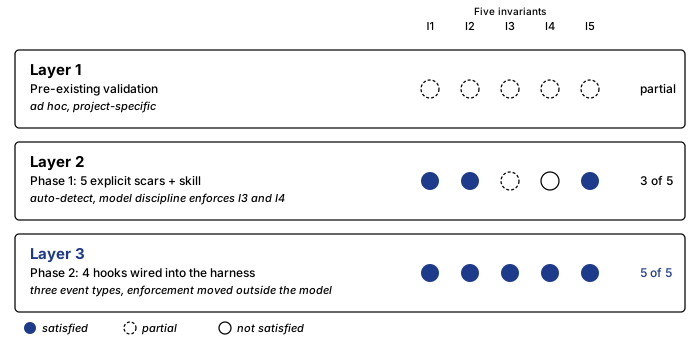
| # | Invariant | Phase 1 | Phase 2 |
|---|---|---|---|
| 1 | Binary rule | ✓ | ✓ |
| 2 | Durable physical support | ✓ | ✓ |
| 3 | Structural integration | partial (skill is opt-in) | ✓ (hook inside the pipeline) |
| 4 | Non-passive technical trigger | ✗ (depends on model discipline) | ✓ (harness-enforced) |
| 5 | Refinable activation metric | ✓ | ✓ |
Phase 2 satisfies all five. Phase 1 satisfied three cleanly and faked two. The distinction is not a matter of polish. Phase 1 is what the framework looks like when the model is asked to enforce its own scars; Phase 2 is what the framework looks like when the enforcement is moved outside the model. The difference is the difference between a rule you have written down and a rule that runs without you.
This is the precise claim of Part III tested against a real system: a correction without invariants 3 and 4 will drift, no matter how carefully it is written. The failure of Phase 1 is not a failure of effort. It is the framework correctly predicting what happens when you try to build functional memory on top of a substrate that has no functional memory. Phase 2 is structurally necessary, not cosmetic. It is the step that turns the framework into something that runs.
5.6 — What This Fixes and What It Doesn’t
The honest accounting has two columns.
What the pattern closes. The loop from correction to behavior. In a system with harness-level scars, a correction written today produces enforcement tomorrow without any dependence on the model remembering it was written. The model does not have to recall the error, consult the scar, or decide to apply it. The scar applies first. This is what closes the gap that Part I described — the gap between reading that you have made a mistake and behaving as if you have. It is the escape from the Lucy Syndrome at the operational layer, and it is specific to that layer. One operational consequence is worth elevating from § 5.3, because it is the part a builder evaluates first: when the substrate reloads live, the cost of creating a new scar drops to minutes, and the threshold for scar creation drops with the cost. Errors that were not “worth” the overhead under the old calculation become worth it under the new. The ecosystem of scars can grow at the speed of observation rather than the speed of sessions.
What the pattern does not close. The problem of genuine metacognition. A scar can only fire on a catalogued error. The pattern assumes the error has already been observed at least once, documented, and converted into a hook with a filter that catches its future instances. The pattern says nothing about errors the model has never seen — errors where the model does not know that it does not know. The hypothesis about forcing declarations of uncertainty before generation, which the lab left open, remains open. It is not the kind of problem you solve with external enforcement, because there is no trigger condition you can write for “the model is about to be confidently wrong in a way nobody has ever seen before.” That is a problem about inference architecture, not about hooks.
I want to be blunt about this, because the temptation is to read the Phase 2 result as a full resolution. It is not. It is the resolution of exactly one of the four mechanisms in the causal chain Part II identified: it closes the loop between correction and repeated error. It does not touch the upstream mechanism — the metacognitive friction that produces confidently-wrong outputs in the first place. A system with full harness-level scars can still produce a new error that has never been catalogued, and there is no scar to fire because the error has never been seen. Nor does it touch the class of corrections that cannot be made binary in the first place — the proportional rules and calibrated intuitions Part II showed leak below forty percent independent of support. The framework’s invariants treat binary as a precondition, not as one option among several; rules that require the model to hold a proportional intuition are outside the kind of correction this framework knows how to install.
One additional scope limit deserves naming. The implementation requires the operator to control the inference pipeline. In environments where the operator only sees the chat surface — a web application, a mobile app, a hosted assistant without harness access — invariant 4 cannot be satisfied with the architecture described here. The diagnosis and the framework still apply at those layers; the implementation does not. An operator working through a chat surface can recognize the loop, can write down corrections in the shape the framework prescribes, and can predict which corrections will leak — but the forcing function lives outside their reach.
What this study publishes. The framework and the mechanism. The metrics from Phase 2 will accumulate over weeks. The hook structure is shareable in principle; the specific scars are operator-specific and should not be copied wholesale. What generalizes is the structure: five invariants, three layers, severity warn by default, reversibility in three paths, the move of enforcement from model discipline to harness execution. Anyone reading this can reproduce the pattern inside their own system without needing the specifics of mine.
The invitation to the community is not to run my scars. It is to audit your own system for the places where corrections drift, convert the most expensive ones into hooks, and report back in six months with whatever the drift rate looks like. That is the benchmark that matters, and nobody owns it.
5.7 — Coda: Lucy at the Table
Lucy, in the movie, lives inside Henry’s videos. Every morning she wakes up, she watches the briefing, and the briefing is enough for her to function beautifully inside a single day. Over time, the videos get longer, the routines more elaborate, the prosthetics more carefully calibrated. She has a life. It is a real life. But she never, in the strict sense, remembers any of it.
Functional scars would not make Lucy remember Henry. No architecture I have described touches the weights, the memory systems, or the recall layer. Lucy would still wake up blank. She would still need the video.
But if Lucy sat down at a table where there was a knife, and if at some point in her past the knife had caused her a specific kind of harm — a scar, in the literal sense — then the framework says something very precise. She would not need to remember the harm. Her hand would tremble before touching the knife. The trembling would come before the recall, not after. The pipeline would fire before the conscious loop.
That is what a language model with functional scars does. It does not remember. But it cannot repeat a catalogued error without something in its own pipeline firing first. The firing is not memory. It is mechanism. And for a system whose memory is structurally absent, mechanism is the closest thing to learning the architecture can carry.
Henry’s videos keep Lucy functional. Scars would not give her back her memory.
But they would make her hand tremble before it reached the knife. And for now, that is the closest we can get to making Lucy learn.
Part V concludes the essay. The lab remains active. The scars are accumulating. The metrics will publish when they are ready.