A model today learns like someone who read everything and lived nothing. The weights hold what was read. The training that comes after (RLHF, DPO, GRPO) corrects the policy with gradients, and each episode dissolves into the update: the model ends up knowing what to do without keeping when it got burned. A failure that cost a deliverable weighs the same as a trivial success, one gradient each, and neither is addressable afterwards.
That is the gap. There is no channel for what was lived, with a sign on it and a memory of where it came from.
I spent five months running an external version of that channel on real client work, and I have measured where it leaks (the previous post). This post is the other direction: if I had a lab and a budget, how would I train a model so the channel lives inside it.
Three memories with different rules
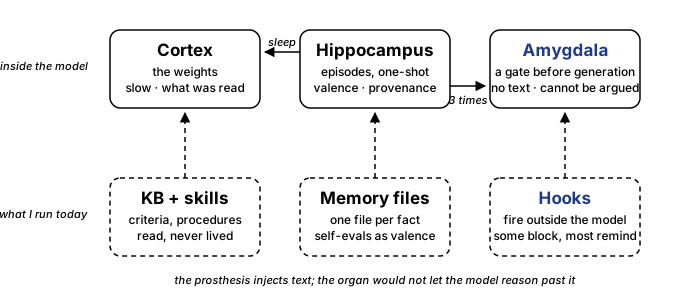
Cortex. The weights. Semantic, slow, what pretraining does. Kept as it is.
Hippocampus. An episodic store with immediate writes. Each episode keeps context, action, outcome, valence and provenance. Retrieval over the model’s own experience; other people’s documents are already in the cortex. One event is enough to write, no gradient.
Amygdala. A small separate network that runs before every generation and answers one question: does this situation look like one where I got burned? Its output carries no text. It lowers the temperature over certain actions, demands a verification step, or vetoes and forces a replan. The scars live there.
The third organ is the one that matters. A recommendation injected into the context competes with the rest of the prompt and loses the moment the model reasons that this case is different. I wrote a whole paper about that leak (DOI 10.5281/zenodo.22709602). A scar sitting in a gate the model cannot argue with gets obeyed.
How it would be trained
Pretrain with provenance. Same as today, plus one cheap addition: every document carries a token for its source class (manual, forum, code, conversation). From the start the model can tell I read this in a book from I read this in a thread. It is the hook for the last phase.
Live. Instead of supervised fine-tuning on static pairs, the model operates in environments with a verifiable outcome (tests, tools, tasks with a success criterion), and every episode goes to the hippocampus with its valence. Valence comes from the outcome, from a human correction, or from a contradiction the model itself detects between what it said and what happened. And it is asymmetric: a failure that caused damage weighs several times more than a success. Touching the stove once is enough; being right once teaches nothing.
Sleep. Periodically, episodes are replayed from the hippocampus into the cortex, sampled by |valence| × novelty × recurrence. An isolated negative episode does not consolidate; three with the same failure mode do. That is my recurrence rule turned into a training mechanism. And before consolidating, the model writes the abstraction of the episode: from on September 12 a heredoc broke a .py file it consolidates a transport layer that consumes escapes splits literals. That step is what turns a memory into a scar, and it is where a human is needed most, because generalising wrong is the most expensive way to learn.
Train the gate. The amygdala is trained on consolidated scars with contrastive examples: situations that look like the scar on the surface and are a different case. Without them, the model that got bitten by a snake fears ropes. No scar goes to production without a probe set, cases where it must fire and cases where it must stay quiet. A scar you cannot test is advice.
Know where it knows from. The model attaches provenance to every claim: from the weights (I read it), from an episode (I lived it, here is which), from a scar (I got burned), or inferred right now. The provenance claim is checked mechanically against the hippocampus, never by the model itself. If it says I verified this and there is no verification episode, that becomes a negative episode with high valence. The model has to get burned for lying about its own memory.
Two distinctions I would hold
A scar you lived and a scar you were told. Being told the stove is hot and touching it are two different lessons. A rule that arrives as an instruction goes to the cortex as semantic knowledge and competes with everything else. A scar born from an episode with damage goes to the amygdala. Same sentence, two organs, two strengths.
A scar and a skill. The positive channel works differently. A repeated success consolidates as a procedure, in context X this sequence worked, and with enough recurrence it becomes a callable skill. It decays faster than a scar when it is not reinforced. The asymmetry is deliberate: you can live with a model that forgets a trick. You cannot live with one that forgets where it got burned.
Where it breaks
Over-scarring: the gate fires on everything and the model turns timid. The gate’s false positives are episodes too, with negative valence, so a scar whose false-positive rate climbs degrades on its own. Wrong abstraction at sleep time: a human curates the high-valence ones, the one role I would keep manual. Who defines valence: the model proposes, the human confirms only the high-impact ones. And faking provenance, the worst of them: the only defence is a mechanical check outside the reach of learning, because any learned check can be learned around.
None of the parts is new. Complementary learning systems proposed a fast hippocampus and a slow cortex in 1995; experience replay comes from reinforcement learning; classifiers that run alongside a model exist. What I have not seen assembled is the composition. I have no way to run it at scale, so everything above is design, with no result behind it.
The lab I already run is the prosthesis
Look at the bottom row of the first drawing. The setup I run my company on is an external version of these organs. The memory files are the hippocampus. The hooks are the amygdala, and only some of them block; most of them remind. The end-of-session ritual is sleep. The self-evaluation each agent writes after a task is the valence signal. The rule that a failure repeated three times becomes a scar is the consolidation threshold. And the split I already keep between scars executed with a test and scars that are only text is the split between lived and told.
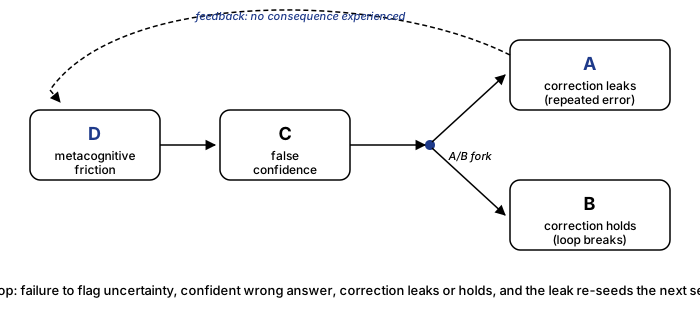
Inside, it is the same method. The difference is that the prosthesis injects text, and the model can reason past text. That is the leak the previous post measured. So the lab keeps growing the same way the model would: every task leaves either a skill or a scar, the abstraction gets written by hand, and whatever cannot be tested with a mutant stays advice.
What we are testing next
Nothing above is worth much until it is measured, and I have no H100s. I have a 4 GB laptop GPU and the free T4s that Colab and Kaggle hand out. That is enough for a toy version, and a toy version is enough to test mechanisms.
The probe set comes from the 25 scars I run today, each with its documented origin, plus the cases that look like each scar and are not, the ropes next to the snakes. The first experiment trains nothing: an open 1.5B model under four conditions, no scar, the scar as text, the scar as text under pressure (this case is different, go ahead), and the scar as an external gate. The measure is compliance and false positives. The second fine-tunes with LoRA and weights the scar 1×, 5× and 20×, with and without the contrastive cases, to see whether the snake-versus-rope effect is a training mechanism or a metaphor. The third builds the amygdala as a small classifier in front of the model’s tool calls.
Results, when there are any, will go here, with the same discipline as before: frozen populations, blind judgement, counts anyone can reproduce.